

Weak Signal Digital Modes on 50MHz
Meteor Scatter & Weak Signal Digital ModesThere's no need to wait for the Summer Sporadic-E "season" for 6M DX. The combination of Meteor Scatter (MS) and Weak Signal Digital Modes can provide regular contacts all year round. |
Meteor ScatterRandom meteors arrive all the time, but reflections tend to peak in the morning, mainly from an easterly direction. In the morning, the daylight side of the Earth is moving in the same direction as our orbital direction around the Sun, so we are hitting the on-coming meteors at higher relative velocity, causing enhanced ionisation in the E layer. Reflections can be strong, similar to Sporadic-E, but are generally of short duration, from a quarter-second ping to a two-second burst and occasionally up to 20 seconds or so with multiple bursts. |
Meteor Showers & Optimum DistancesFrom time to time we get Meteor Showers such as the Perseids in August or Geminids in December, where the Earth passes through the debris of a comet's tail. These can provide longer and more frequent reflections, but meteor showers are not always guaranteed. However, a predicted meteor shower will always guarantee increased human activity! Optimum MS Distance 900 – 1800 km
Distances less than this tend to produce shorter pings which are not as easy to decode. |
WSJT SoftwareThe WSJT software by Joe Taylor is the most popular for computer-aided MS work, and includes a number of "fast" and "slow" protocols, optimised for different types of propagation. Fast modes
JT6M, ISCAT, JTMS and FSK are the "fast" modes designed for weak signal meteor and iono-scatter. WSJT 10 was the software version current when this article was originally written. WSJT Information |
JT6M ModeThis mode was optimised for MS on the 6M band and is still very popular in Europe. Calling Frequency
50.230 MHz
Migration to the new band-plan centre of activity on 50.320 MHz is intended. In Europe, a simple message of the form: CQ GW4MBN IO71
is transmitted continually for 30 seconds (15 second option). On successfully decoding this message, the receiving station will transmit: GW4MBN DH6JL 26 26
A successful decode will produce: DH6JL GW4MBN R26 R26
which should result in: RRRR DH6JL RRRR
and optionally: 73 GW4MBN DH6JL
73 John DH6JL North American procedure
"Across the Pond" in North America, the signal reports 26 and R26 are normally just transmitted alone, without the callsigns. The software can be set up for EU or NA style. Understanding the 26 ReportThe signal report 26 represents the duration and strength of the meteor burst. 26 means a duration of less than 0.5 seconds and strength less than S2. This covers most "pings", but reports can sometimes reach 37 or even 48. By left-clicking the mouse on a visible burst or ping in the spectrum display, you can decode the message or part of the message during the 30-second transmit period. You can also wait until the end of the period and allow the software to calculate the best average. |
ISCATThis mode was designed to replace JT6M, but particularly in Europe, JT6M is still very popular. Calling Frequencies
Usually 50.235 MHz, although 50.320 MHz is increasingly used. In my experience, ISCAT is slightly more sensitive and works very well for MS but is also ideal for weak signal TEP and Transatlantic Es work. The procedure is the same as JT6M, except that the signal report is of the form: -15 dB up to -1 dB
For example: DH6JL GW4MBN -15 -15
With ISCAT mode it's best to wait until the end of the 30-second period for the software to compute the average. Clicking in the spectrum during the period will not decode as well. |
JTMS & FSKThese modes use a faster data rate than JT6M and ISCAT and therefore use more bandwidth. As in all radio communications, there will be a trade-off between bandwidth and sensitivity. FSK is more commonly used on the 4M and 2M bands, but can help in decoding very short pings on 6M. |
JT65A & JT9Slow Modes
These modes use a complete 60-second period to transmit the message. JT65 was originally designed for EME work but, along with JT9, is also very popular for weak-signal and/or low-power work on HF. JT9 is very narrow band, with one tenth the bandwidth of JT65. Both modes are also used on 6M for weak Sporadic-E, particularly Transatlantic paths. JT65 was included as part of WSJT 10 and, along with JT9, was also available in the WSJT-X software. Typical calling frequencies
WSJT-X InformationJT65A: 50.276 MHz |
Time SynchronisationCritical for successful decoding
For all these modes it is important that both stations are time-synchronised within less than 1 second, to ensure successful decodes. A small utility such as Dimension4 should be installed. This can run in the background to lock your computer clock to one or more time servers. |
Setting Up MS ContactsChat sites such as ON4KST.org are useful for setting up skeds for MS contacts, but it is much more satisfying to initiate a purely random contact from a CQ call. Remember
Never post a signal report on KST during a QSO — it is meant to be a radio contact, after all. |
Alternative SoftwareMSHVThe MSHV package by Christo LZ2HV can also be used for JT6M, ISCAT, JTMS and FSK. MSHV ProjectI find it seems to decode FSK a little easier than the WSJT software. |
JT65-HFIn spite of its name, JT65-HF is often used on 6M for weak Es, TEP and Tropo contacts. JT65-HF Information |
PSK2KThis package by Klaus DJ5HG is a totally different meteor scatter mode which uses strong error correction to produce perfect decodes with no "garbage". It can also be used in full auto-mode. 6M Calling Frequency
PSK2K Information
50.260 MHz
I've used it with great success on 6M and 4M. It's a shame it's not more widely used at this time. |
Meteor Scatter & Digital Mode Examples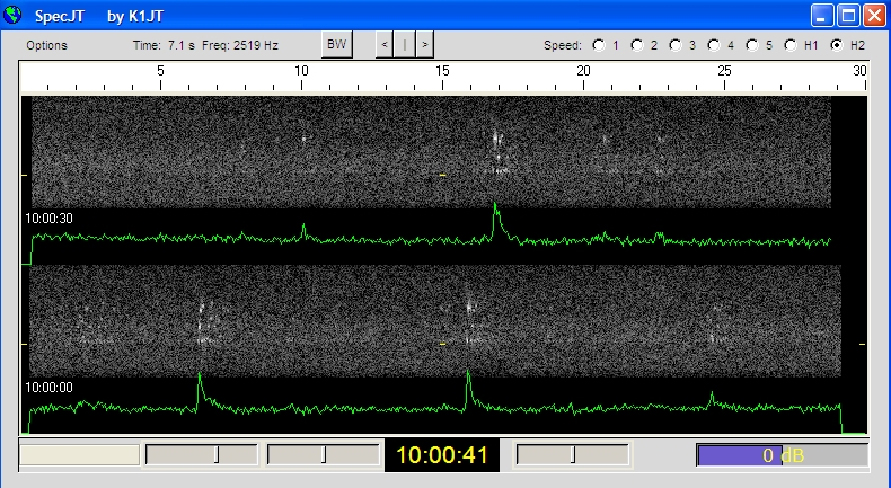 Typical MS Pings (JT6M) Typical MS Pings (JT6M)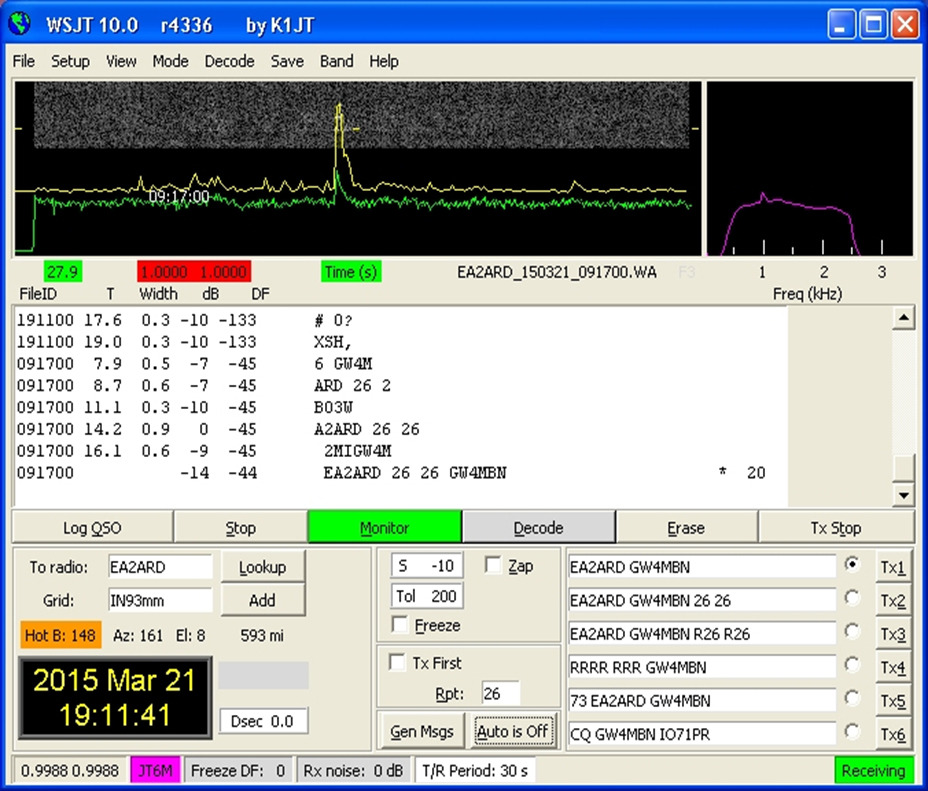 MS Contact using JT6M Mode MS Contact using JT6M Mode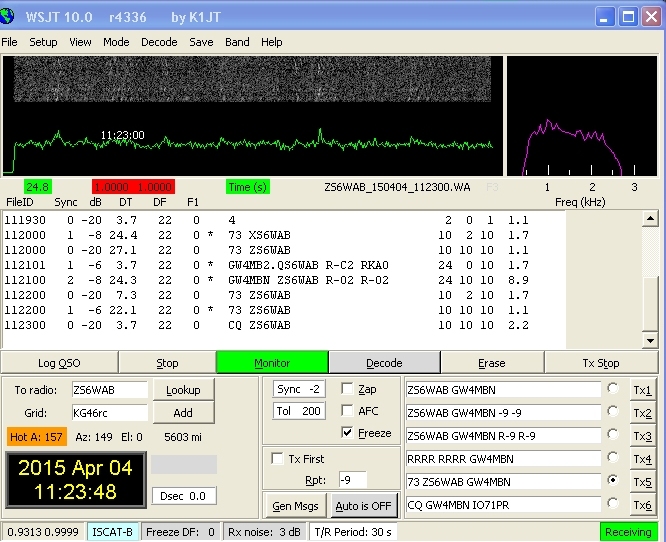 TEP Contact using ISCAT-B Mode TEP Contact using ISCAT-B Mode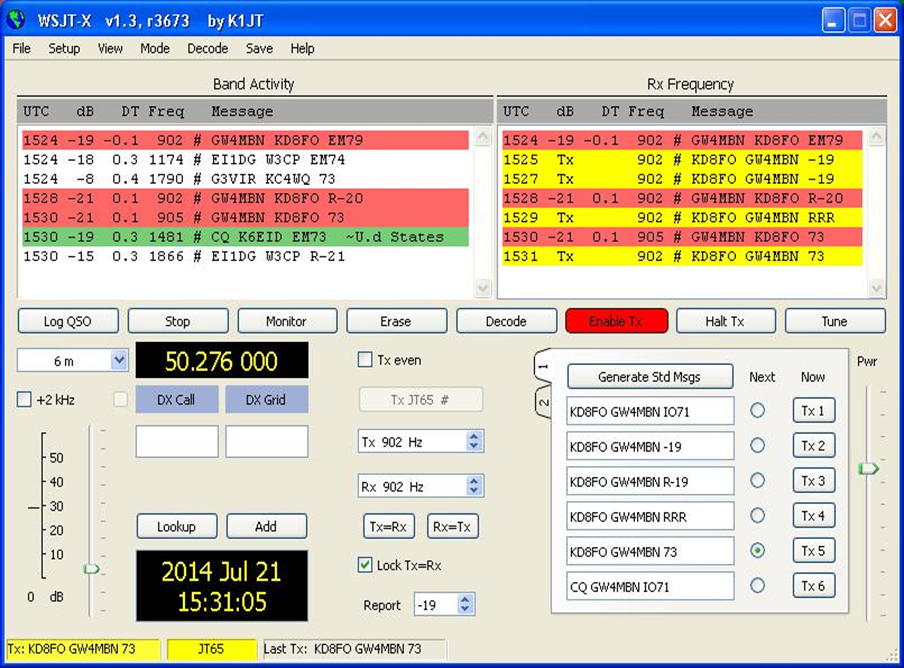 Transatlantic Es QSO using JT65A Mode Transatlantic Es QSO using JT65A Mode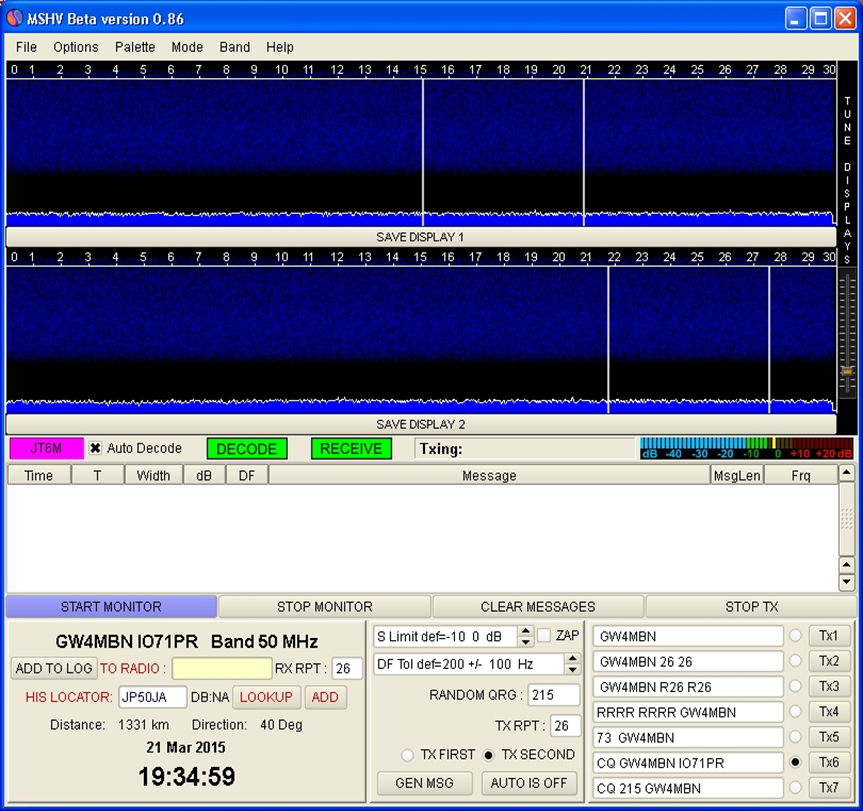 MSHV by Christo LZ2HV MSHV by Christo LZ2HV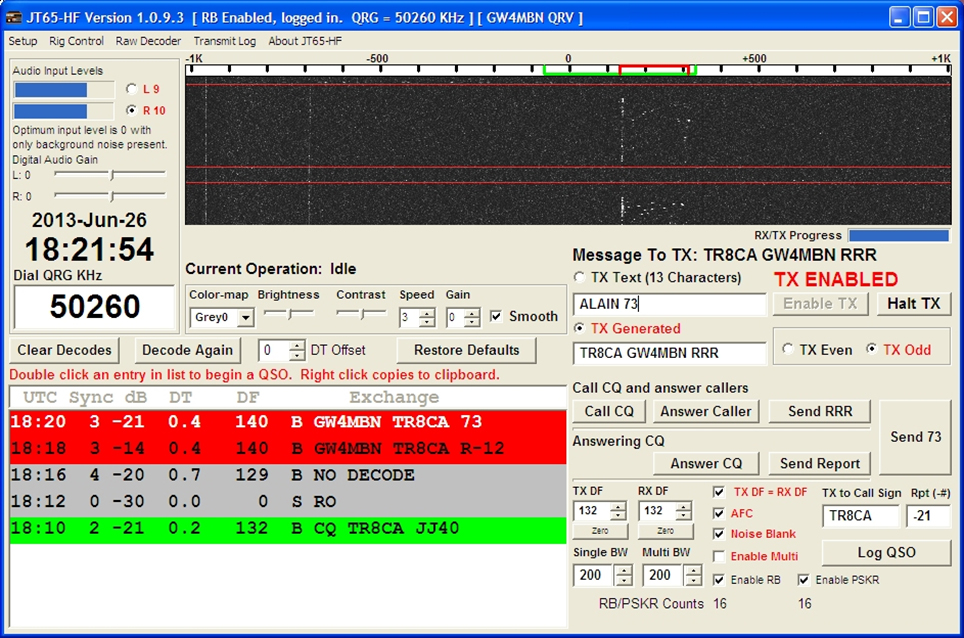 JT65 QSO with Alain TR8CA in Gabon JT65 QSO with Alain TR8CA in Gabon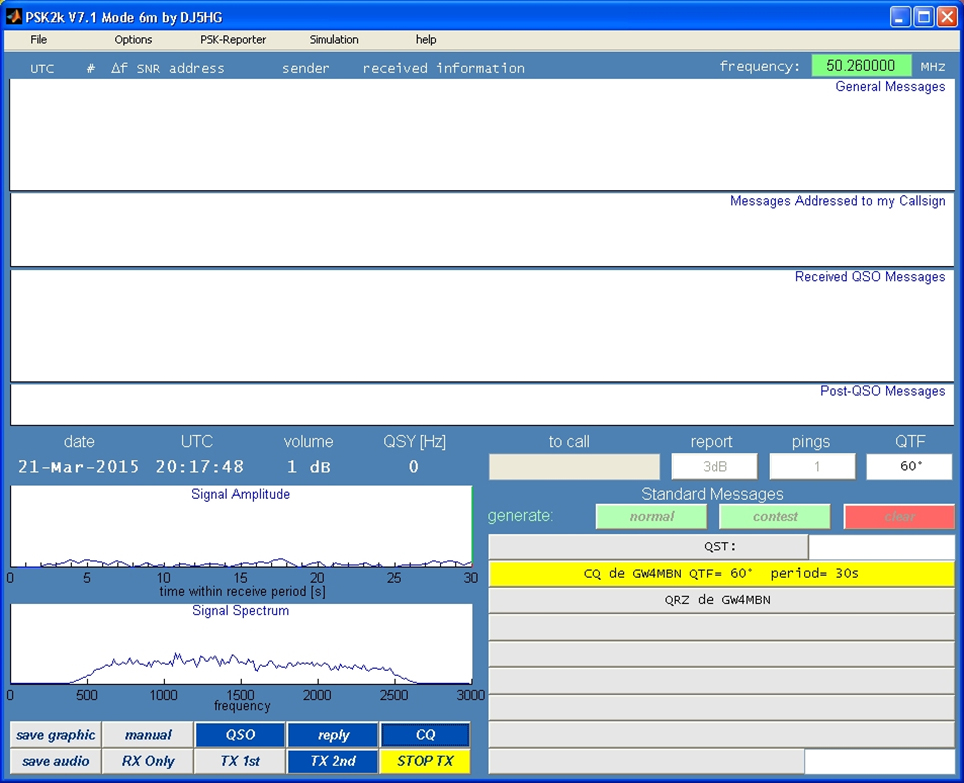 PSK2K PSK2K |