
The UK Six Metre Group

The UK Six Metre Group

The UK Six Metre Group
Dedicated to promoting 50MHz activity around the world.
  • UKSMG
    • Home
    • Six News
    • Trophies
    • Latest News
    • Join the UKSMG
    • Renew Your Membership
    • About Us
    • Contact Us
  • Operating on Six
    • DX-Desktop
      • Statistics
    • Standings
      • All Time
      • EME Standings
      • Annual Table
      • IOTA
      • QRP
    • 6M Contests
      • Contest Page
      • Contest Calendar
    • UK Firsts
    • Beacons
      • Synchronised Beacon Project
    • Repeaters
    • Awards
    • Bandplans
      • UK Bandplan
      • IARU Region 1 Bandplan
      • IARU Region 2 Bandplan
      • Bandplan Comparison
    • Licensing
    • Code of Practice
  • Login/Register
  • DX Sponsorship
    • Sponsorship Program
    • Sponsorship Conditions
    • Past Sponsorships
  • Getting Started
    • New to Six
    • FT8
    • Other Digital Modes
  • Other Resources
    • UKSMG Archive
    • ON4KST Chat
    • Spaceweather.com
    • SolarHam.net
    • Global foF2 Map
    • Kiruna Magnetogram
    • Hepburn Tropo Maps
    • Lightning Map
    • Meteor Radar
    • Global Jet Stream Forecast
    • GOES XRay Flux (Dynamic Plot)
  • Members
  • UKSMG
    • Home
    • Six News
    • Trophies
    • Latest News
    • Join the UKSMG
    • Renew Your Membership
    • About Us
    • Contact Us
  • Operating on Six
    • DX-Desktop
      • Statistics
    • Standings
      • All Time
      • EME Standings
      • Annual Table
      • IOTA
      • QRP
    • 6M Contests
      • Contest Page
      • Contest Calendar
    • UK Firsts
    • Beacons
      • Synchronised Beacon Project
    • Repeaters
    • Awards
    • Bandplans
      • UK Bandplan
      • IARU Region 1 Bandplan
      • IARU Region 2 Bandplan
      • Bandplan Comparison
    • Licensing
    • Code of Practice
  • Login/Register
  • DX Sponsorship
    • Sponsorship Program
    • Sponsorship Conditions
    • Past Sponsorships
  • Getting Started
    • New to Six
    • FT8
    • Other Digital Modes
  • Other Resources
    • UKSMG Archive
    • ON4KST Chat
    • Spaceweather.com
    • SolarHam.net
    • Global foF2 Map
    • Kiruna Magnetogram
    • Hepburn Tropo Maps
    • Lightning Map
    • Meteor Radar
    • Global Jet Stream Forecast
    • GOES XRay Flux (Dynamic Plot)
  • Members

New to Six

Operating on Six Metres

Like most bands, where you operate in the band is largely dictated by the mode you are using. If you are transmitting SSB it will generally mean you will be somewhere between 50.125 and 50.300. You may occasionally hear stations operating down as far as 50.100 using SSB but, by general agreement, the area between 50.100 and 50.125 tends to be used for intercontinental, and preferably long haul, DX working.

There are a few contests that include the 6m band. You will notice that contest stations using SSB do not operate below 50.130MHz in order to preserve the DX portion of the band.

As with most other bands, CW may be used anywhere that SSB can plus an additional 20kHz at the low end — from 50.080 to 50.300MHz. In practice, most CW operation takes place between 50.080 and 50.100 MHz.

Again, during periods of high activity and especially if the band is open to long haul DX, some activity may be heard below 50.080MHz, although it is very rare for activity to take place below 50.070MHz. The 6m band supports many other modes of transmission and we would encourage new users to study the current band-plan to gain a better appreciation of what is happening where.

Along with several other international groups UKSMG recommend adherence to the 6m Code of Practice. It contains useful and practical operating tips. The Code of Practice may be found on our website by following the link at the bottom of each page.

The DX Calling Frequency

50.110 MHz is probably the most monitored frequency in the entire amateur bands allocation. This is the intercontinental DX calling frequency, and is where the first signals during an opening are likely to be heard.

DX operators will often make their first calls on 50.110 MHz so it makes sense to think carefully before calling CQ here. The very variable footprint of most forms of propagation will mean that a station just a few miles from you may be hearing stations below your noise floor; a few minutes later the situation could well be reversed!

Responding to a DX call here is a different matter and you may well find yourself one of many callers. Once contact is established on 50.110, stations are encouraged to QSY elsewhere, leaving the calling frequency free.

There is a good article on how to handle pile-ups and the use of 50.110 here. It may be over twenty years old but is just as relevant today as it was then.

How to Handle 6m Pile-Ups

Propagation Modes

Tropospheric Propagation

Tropo is similar to 2m. Power for power the ranges are much the same and, as with 2m, this is the predominant mode of propagation.

Extended Tropo

Tropospheric ducting occurs very much less often than on 2m. In addition, signals tend to be weaker and ranges not as great.
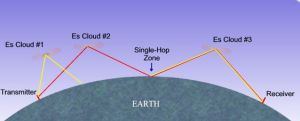
Sporadic E

On 6m, popularly referred to as Es, Sporadic E is ideal for those who operate QRP and/or with small or poorly sited aerial systems. Whereas 2m will support Es perhaps a dozen times a year for maybe two hours at best, 6m can seem to be one long Es opening during the summer.

Even if the band appears to be quiet during these periods, there is usually a sporadic E opening to somewhere in Europe. Double-hop Sporadic E is not unusual, allowing all of Europe and the near east coast USA to be worked on occasions.

Multi-hop Sporadic E, that is three or more hops, is less common but allows fairly long-haul contacts; for example well into Asia, the USA or into central Africa.

In the northern hemisphere most sporadic E occurs during the summer months; generally from late April through to late August with a pronounced peak during June/July. Some sporadic E occurs during the winter also, usually around December, but these openings are generally not as prolonged as during the summer months.

Sporadic E Diagram

Stations with low power and small antenna systems often take advantage of Sporadic E and many successful contacts into Europe and on occasions the USA have been made running less than one watt to a wire dipole in the loft.

The variable footprint of Sporadic E is a boon to those with basic equipment and antennas for 6m. It allows the QRP operator to occasionally hear and work stations that perhaps cannot be heard by some of the “big guns” on the band.

This aspect of 6m is particularly appealing and is another reason for the “Magic Band” sobriquet. An excellent article on the subject can be found in our archives here.

About UsPrivacyConstitutionStrategyCode of Practice
© ℗ UKSMG Unless otherwise stated, all content copyright UKSMG. This Web site is published on a strictly non-profit basis but please note that UKSMG is not a registered non-profit organisation. The opinions expressed are the opinions of the authors alone and not that of any associated organisations or employers or hosting Internet service providers. No material may be used in other media unless full credit is given to the UK Six Metre Group or the credited original source of the material.